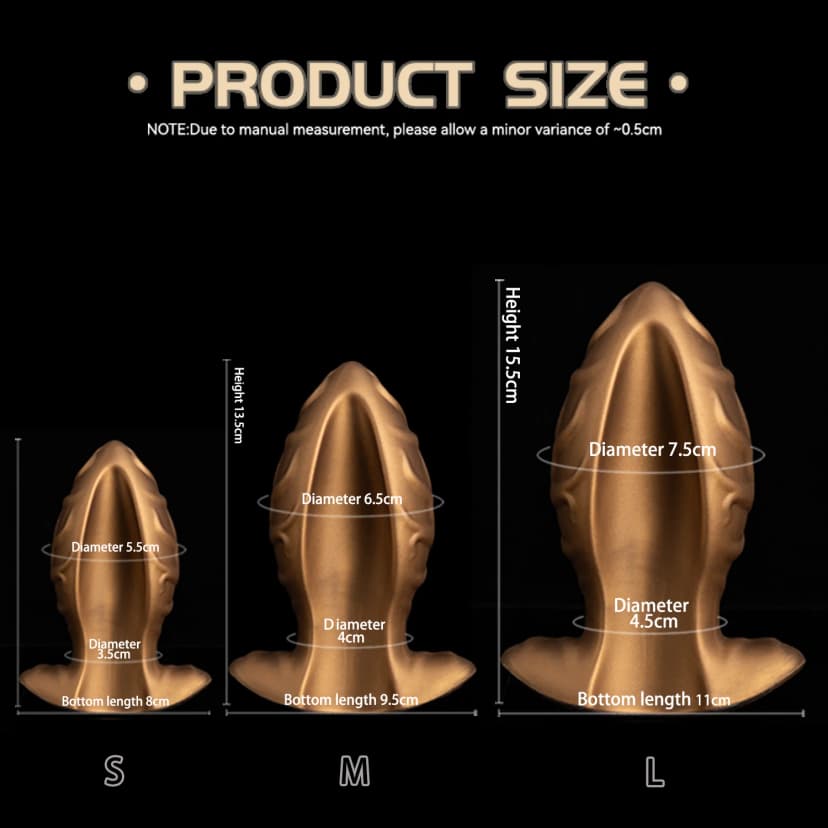
size-and-fit
Anal Plug Size Guide: Diameter, Neck, and Progressive Sizing
7 May 2024 · 13 min
Anal Plug Size Guide: Diameter, Neck, and Progressive Sizing
The most common mistake in anal toy selection is confusing what size actually matters. Most guides focus on the insertable length. That's almost irrelevant for anal plugs.
What matters is diameter—the widest part that goes in—and neck—the narrower part between the bulb and the base. These two dimensions determine comfort, function, and safety. Length barely matters.
This guide explains why diameter and neck are critical, how to assess your body's readiness for different sizes, and how to progress safely from beginner to advanced.
The Anatomy That Determines Sizing
Understanding anal anatomy is essential to understanding plug sizing.
The Sphincters
The anus has two sphincters: the external (which you can voluntarily control) and the internal (which you can't). They're rings of muscle, roughly 1–1.5 inches apart. Both can hold or release material passing through them.
When you're relaxed, both sphincters are partially closed. During arousal or deliberate relaxation, they loosen. The tighter you are, the smaller a toy needs to be to fit comfortably. The more relaxed you are, the larger a toy you can accommodate.
The Neck: The Critical Dimension
Once inside, a plug sits between the two sphincters. The narrowest part of the plug (the "neck") is what the internal sphincter grips. This is the dimension that determines comfort.
A neck that's too wide will feel like constant pressure (uncomfortable). A neck that's too narrow will let the plug move around (less sensation, less retention). The neck is more important than the bulb size.
Most anal plugs have a pronounced neck—the bulb is wider, then narrows to a shaft/base connector. The neck diameter determines how comfortable the plug is to wear.
Bulb Diameter and the Stretch Sensation
The bulb is what creates the stretch sensation, the "fullness." Larger bulbs create more sensation. But the limiting factor is how much the external sphincter can accommodate to insert the plug, and how much pressure the internal sphincter can comfortably sustain.
For most people without extensive anal experience:
- External sphincter maximum comfortable insertion: 2–2.5 cm diameter
- Internal sphincter sustainable comfort: 1.5–2 cm neck width
A plug with a large bulb but a narrow neck (tapered plug) is more comfortable than a plug with a large bulb and large neck (blunt plug) at the same bulb size.
Size Tiers by Experience Level
Beginner (Narrowest)
Maximum diameter: 2.5–3 cm (0.98–1.18 inches) Neck diameter: 1.5–2 cm (0.59–0.79 inches) Shape: Tapered (bulb is wide, neck narrows significantly) Length: 2–4 inches insertable (actual depth doesn't matter much)
Why tapered: The taper lets the external sphincter slowly dilate during insertion. The narrower neck means the internal sphincter isn't holding a large diameter—it's holding something slender.
Material: Silicone or glass. Silicone is forgiving (flexible, smooth, easy). Glass is smooth and non-porous (easy to clean).
Common beginner plugs:
- Silicone tapered plugs with retrieval cord
- Small glass butt plugs (3–4 cm bulb max)
- Trainer set (3 progressively larger plugs)
Intermediate (Moderate)
Maximum diameter: 3–4 cm (1.18–1.57 inches) Neck diameter: 2–2.5 cm (0.79–0.98 inches) Shape: Can be more blunt (less taper) Length: 3–5 inches insertable
Why this size: After 2–4 weeks of beginner plug use, the sphincters are more relaxed and stretched. You can accommodate larger diameter without pain.
Progression: Usually this is the second or third plug, not the first. Don't skip from beginner to intermediate. Progress gradually.
Material: Silicone, glass, or metal. Metal adds temperature play sensation.
Advanced (Larger)
Maximum diameter: 4–5+ cm (1.57–1.97+ inches) Neck diameter: 2.5–3.5+ cm (0.98–1.37+ inches) Shape: Can be blunt or complex (textured, ridged, knotted) Length: 4–7 inches insertable
Why this size: After months of progressive use, sphincters can sustain larger sizes. Advanced users often use plugs not for insertion/stretch sensation, but for the internal pressure sensation they provide throughout the day.
Who this is for: People with significant anal play experience, not beginners.
[INSERT COMPARISON TABLE: plug diameter, neck diameter, length, material, level — sorted diameter ascending]
Material Choices and Their Impact
Silicone
What it is: Medical-grade or toy-grade silicone, flexible and smooth.
Pros:
- Smooth, comfortable insertion
- Flexible (forgiving of positioning changes)
- Body-safe (non-porous)
- Easy to clean (soap and water, boil to sterilise)
- Wide range of sizes and shapes
- Affordable (£10–30 for beginner plugs)
Cons:
- Degrades over years (loses elasticity, eventually cracks)
- Can absorb stains or odours over time
- Less firm sensation than glass or metal
Best for: Beginners, people wanting comfort and ease, progressive users building a collection.
Glass
What it is: Borosilicate glass, non-porous and extremely smooth.
Pros:
- Extremely smooth (easiest insertion)
- Non-porous (can be fully sterilised by boiling)
- Temperature play (can be warmed or chilled)
- Very durable (glass doesn't degrade)
- Clean aesthetic appeal
- Easier to keep hygienically clean than silicone
Cons:
- Breakable if dropped on hard floors
- Can be cold initially (quickly warms to body temp)
- More expensive (£20–50)
- Usually smaller diameter range than silicone
Best for: People valuing ease of sterilisation, anyone wanting the smoothest insertion, people with silicone sensitivities.
Metal (Stainless Steel)
What it is: Surgical stainless steel, rigid and firm.
Pros:
- Extremely firm (intense sensation)
- Temperature play (warmth and cold very noticeable)
- Extremely durable
- Non-porous (fully sterilisable)
- Heavy (adds pressure sensation)
- Premium feel
Cons:
- Rigid (less forgiving than silicone or glass)
- Can be uncomfortable if sizing is wrong (can't flex)
- More expensive (£25–60)
- Cold initially (though warms quickly)
- Usually only available in intermediate/advanced sizes
Best for: Experienced users, people wanting firm sensation and temperature play, anyone valuing durability.
Avoid: TPE/Jelly
Why avoid:
- Porous (bacteria colonise; can't be fully sterilised)
- Contains phthalates (potentially harmful)
- Degrades quickly
- Tears easily
Plug Shape: Bulb vs Tapered vs Rippled
Bulbous (Simple Bulb)
A single rounded bulb with a narrow neck and base. Most common shape.
Sensation: Straightforward fullness, insertion stretch.
Best for: Learning anal play, any experience level if sized correctly.
Tapered
The bulb smoothly tapers from wide to narrow as you move toward the base. Easiest insertion.
Sensation: Gradual stretch during insertion, then comfort from the narrow neck.
Best for: Beginners, anyone who struggles with blunt insertion.
Rippled or Ridged
Multiple ridges or undulations on the bulb surface.
Sensation: Enhanced texture, more complex sensation.
Best for: Experienced users wanting texture variety.
Weighted or Hollow with Ball
A plug with a rolling inner ball (like Ben Wa balls inside the plug) or significant weight.
Sensation: Movement sensation as you move; internal stimulation from the rolling element.
Best for: Experienced users, wearing for extended periods.
Progression: How to Size Up Safely
You shouldn't move from beginner to intermediate immediately. Gradual progression is safer and more pleasurable.
Progression Timeline
Week 1–2: Use beginner plug (usually for 10–30 minutes during solo play or with a partner).
Week 3–4: Continue beginner plug. Increase wearing time to 30–45 minutes. Start using during partnered penetration (hands-free sensation).
Week 5–6: If comfortable, introduce intermediate plug occasionally. Don't stop using beginner plug—just alternate.
Week 7–8: Beginner plug feels very comfortable. Can wear longer. Intermediate plug becomes standard.
After 2 months: Intermediate plug feels normal. Can wear during extended play or for 1–2 hours comfortably.
After 3–4 months: If interested in larger sizes, introduce advanced plugs occasionally.
Signs You're Ready to Size Up
- Current plug feels comfortable after 30+ minutes
- Insertion is effortless (no resistance)
- You want more sensation (fullness, pressure)
- The current plug has become "boring" (you've adapted)
Signs You're NOT Ready to Size Up
- Insertion causes pain or significant discomfort
- Wearing for more than 10–15 minutes causes aching
- You're forcing insertion instead of it sliding in with lube and relaxation
- You're not fully comfortable with the current size yet
Wait. Progression is fine—rushing to larger sizes is how you get injured or develop negative associations with anal play.
The Importance of the Flared Base
Non-negotiable: Every anal plug must have a flared base (wider base than the bulb). This prevents the plug from sliding completely inside.
Never buy a plug without a flared base. This is a safety baseline, not a preference.
Some plugs have:
- Retrieval cord (attached string)
- Wide flat base (stays outside the body)
- Anchor design (hooks externally)
All of these accomplish the same thing: preventing full insertion. Choose whichever feels most comfortable.
Lubrication: Essential for Comfort
Anal insertion needs abundant lubrication. The anus doesn't self-lubricate. Inadequate lube is the #1 reason people have bad anal experiences.
Lube Type
Water-based lube: Works with silicone, glass, and metal. Easiest cleanup. Can be reapplied during use (just add more). Dries out with time (requires reapplication during extended sessions).
Silicone-based lube: Works with metal and glass. Do NOT use with silicone toys (it degrades silicone). Longer-lasting (doesn't dry out). Harder to clean up.
Oil-based lube: Works with everything. Longest-lasting. Stains fabrics. Can be used with silicone (unlike silicone lube).
Amount
Use more lube than you think you need. A good guide: cover the plug entirely and generously lube the anal opening. If using water-based lube and the session lasts more than 10 minutes, add more.
How to Insert Safely
Preparation
- Clean the area. Shower or use a bidet. You don't need to douche (internal rinse) for anal play with a plug, but you can if you prefer.
- Relax and get aroused. Arousal relaxes the sphincters. Relaxation is more important than arousal; a calm state helps more than rush.
- Prepare the space. Lube within arm's reach, partner ready to assist if needed, no time pressure.
Insertion Step-by-Step
- Assume a comfortable position. On back with knees bent, or on all fours, or standing leaning forward. Whatever relaxes your hips and allows you to reach.
- Apply lube generously to the plug and anal opening.
- Breathe and relax. Shallow breathing keeps you tense. Deep belly breathing relaxes the sphincters.
- Start with gentle pressure. Press the tapered tip against the opening. Don't force. Gentle, steady pressure, breathing through any sensation.
- Let it slide in. With continued gentle pressure and breathing, the external sphincter will gradually relax and allow entry. This takes 30–60 seconds.
- Once past the external sphincter, the plug will slip in the rest of the way (the internal sphincter holds it once inserted).
- Adjust positioning. The plug should rest comfortably inside with the base external and the neck inside. Adjust if needed.
- Rest. Sit with it for a minute. Let your body adjust. Any initial discomfort usually fades within 1–2 minutes.
If Insertion Hurts
Pain is not normal. Pressure, stretch sensation, and fullness are normal. Pain is a signal something is wrong.
- Stop. Remove the plug.
- Assess: Was lube inadequate? Were you tense? Was the plug too large?
- Re-lube and try again. More lube, deeper breathing, slower insertion.
- If pain persists: Use the plug again next time, or choose a smaller size. Don't push through pain.
Wearing Duration and Limits
Safe wearing duration: 1–4 hours continuously. Different people have different limits.
After 1–2 hours, most people feel fine. After 4 hours, fatigue and soreness can develop. Extended wear (all day) is possible for experienced users with properly-fitted plugs, but not for beginners.
Signs to remove:
- Significant aching (different from stretch sensation)
- Numbness
- Anal bleeding or injury
- Discomfort that worsens rather than fades
Remove, rest, and reassess. Most discomfort is from incorrect sizing, not inadequate experience.
Cleaning and Storage
After Use
Silicone: Rinse under warm water. Use soap and water for thorough cleaning. Air dry.
Glass: Rinse under warm water. Can be boiled (10 min) for sterilisation. Can be washed in the dishwasher (top rack, no detergent) or by hand.
Metal: Rinse under warm water. Can be boiled or washed with soap. Air dry.
Between Sessions
Store plugs in a cool, dry place. Some people use toy storage bags (available on Amazon). Most plugs can be stored naked in a clean container.
Sterilisation
All materials can be sterilised by boiling for 10 minutes. This is good practice if sharing plugs, or if you've had a break from anal play and want a fresh start.
Silicone and glass can be boiled. Metal can be boiled. Do NOT boil anything with electronics (vibrating plugs) unless the manufacturer specifies it's waterproof.
Trainer Sets: A Smart Beginner Approach
A trainer set is three plugs in graduating sizes (usually beginner, small intermediate, large intermediate). They're designed to be used in sequence over 4–8 weeks.
Why they're smart:
- All three plugs are designed for progressive use
- More economical than buying three plugs individually
- Remove guesswork from size progression
- Built-in progression plan
Typical trainer set sizing:
- Plug 1: 2.5–3 cm diameter, 1.5–2 cm neck
- Plug 2: 3–3.5 cm diameter, 2–2.3 cm neck
- Plug 3: 3.5–4 cm diameter, 2.3–2.5 cm neck
When to buy a trainer set: You're serious about anal play and want a structured progression. This is a better first purchase than a single large plug.
Common Mistakes and Safety
Mistake: Skipping Ahead in Size
Jumping from a beginner plug to an advanced plug because the beginner size feels small is how people get injured.
Feeling small ≠ you're ready to size up. Small plugs feel small because the internal sphincter barely has to work to hold them. Larger plugs feel completely different.
Progress gradually. Use each size for 2–4 weeks minimum.
Mistake: Using Inadequate Lube
The second-most-common mistake. Anal tissue doesn't self-lubricate. Dry insertion = pain and potential micro-tears.
Use generously. Use more than you think you need.
Mistake: Forcing Insertion
If it doesn't slide in within 30–60 seconds of gentle pressure, something is wrong. Either:
- Not enough lube
- You're tense (breathe, relax)
- The plug is too large
- You need more arousal/relaxation time
Don't force. Forced insertion causes injury. Give it time.
Mistake: Sharing Plugs Without Sterilisation
Anal bacteria can transfer to other body parts. Never share plugs without sterilising (boiling) first.
Same applies if you move from anal to vaginal play—never insert into the vagina anything that's been in the anus without thorough cleaning or sterilisation.
Final Thoughts: Start Small, Progress Slowly
The most successful anal plug experiences start with a correctly-sized beginner plug, patient progression, abundant lubrication, and relaxation. There's no rush.
A tapered silicone beginner plug (2.5–3 cm max diameter) is the ideal first purchase. Use it for 2–4 weeks, then assess if you want to progress. Most people who enjoy anal play end up using a trainer set over 2–3 months, then settling on an intermediate plug as their preferred size.
Rushing to larger sizes doesn't increase pleasure. Patience, proper sizing, and relaxation do.